


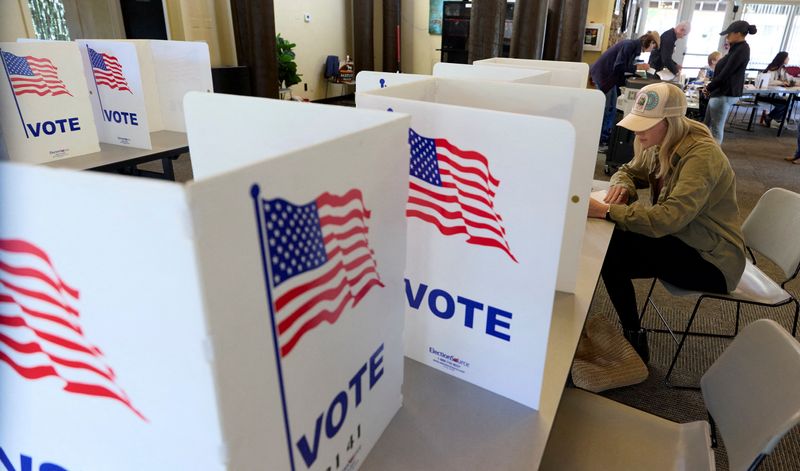
The gerrymandering wars continue: judicial deference or partisan calculation?
The Supreme Court declined intervention. California’s Democratic-drawn congressional map—challenged by Republican plaintiffs as partisan gerrymandering—will stand for the 2026 midterm elections. The unsigned order, issued without noted dissent, maintains judicial silence on redistricting standards that has characterized the Roberts Court’s approach to electoral map-making .
The practical impact is immediate: four additional Democratic-leaning seats in a state where the party already holds 40 of 52 congressional districts. The strategic context is national: California’s map contributes to Democratic efforts to offset Republican advantages in Texas, Florida, and Ohio, where similar partisan drawing has proceeded without federal judicial restraint .
The California Map
Democratic supermajority control of the California legislature produced aggressive gerrymandering following the 2020 Census. The Citizens Redistricting Commission—created by 2008 ballot initiative to remove partisan manipulation—was circumvented when Democrats passed new legislation claiming Voting Rights Act compliance required revised boundaries .
The resulting map: consolidated Republican incumbents into fewer winnable districts, diluted GOP-leaning suburbs across multiple Democratic seats, and protected vulnerable Democratic freshmen with favorable boundary adjustments. Republican challengers filed federal lawsuit alleging 14th Amendment equal protection violation and First Amendment retaliation .
Lower courts split: district court dismissed the challenge under Rucho v. Common Cause (2019), which held partisan gerrymandering claims non-justiciable; Ninth Circuit panel reversed, finding state-specific standards potentially enforceable; en banc rehearing vacated the panel decision, restoring dismissal. The Supreme Court’s denial of certiorari ends federal litigation .
The Rucho Legacy
Chief Justice Roberts’ 2019 opinion—5-4, partisan gerrymandering claims beyond judicial competence—established federal court abstention. The reasoning: no manageable standard for “fair” partisan balance; political question better resolved through democratic process; state courts and legislatures appropriate fora for redress .
The practical consequence: unrestrained partisan map-drawing in states with single-party control. Republicans gerrymandered Texas, Florida, Ohio, Georgia, North Carolina; Democrats responded in California, New York, Illinois, Maryland. The 2022-2024 elections proceeded under maps that systematically advantaged incumbents and polarized representation .
State court intervention—Pennsylvania, North Carolina, New York—provided partial check, but variable standards and political judicial selection produced inconsistent outcomes. The Supreme Court’s California denial reinforces federal non-involvement, leaving state-by-state fragmentation .
The Democratic Strategy
California’s aggressive gerrymandering—defended by voting rights advocates as necessary counterweight to Republican manipulation elsewhere—reflects national party calculation. The 2022 House popular vote produced Republican majority despite Democratic vote share advantage; structural bias in Senate and Electoral College compounds geographic disadvantage .
Unilateral disarmament—California reform while Texas consolidates—struck Democratic strategists as electoral suicide. The “fight fire with fire” approach, morally contested, proceeded through state legislative majorities and gubernatorial support, with judicial validation via federal abstention and state court deference .
The 2026 map—now Supreme Court-approved—provides 4-6 seat Democratic advantage in chamber where 5-seat margin determines committee control and legislative agenda. The gerrymandering contribution to national governance exceeds California’s substantive policy importance .
The Republican Response
Legal avenues exhausted, Republicans pursue political countermeasures: California recall efforts against redistricting legislators, ballot initiatives to reinstate independent commission, and national messaging on Democratic hypocrisy regarding “voting rights” and “democratic norms” .
The strategic vulnerability: Republican-controlled states have already maximized gerrymandering; Democratic states had residual capacity that California exploited. The asymmetric counter-mobilization— Texas cannot further consolidate; California could further optimize— frustrates GOP response .
Federal legislative prohibition— For the People Act, Freedom to Vote Act— remains blocked by Senate filibuster and Supreme Court skepticism. The constitutional amendment pathway— requiring supermajorities unattainable in polarized environment— is theoretical rather than practical .
The Institutional Critique
The Supreme Court’s abstention— California denial following Rucho precedent— draws academic criticism: judicial abdication of protective responsibility; democratic process assumptions belied by gerrymandered maps themselves; state court incapacity given political judicial selection .
Defenders counter: partisan balance is irreducibly political judgment; federal judicial involvement would produce legitimacy crisis given Court’s own partisan perception; state-level experimentation— some reform, some consolidation— generates information for eventual national standard .
The intermediate position: Rucho correctly identified standard difficulty but incorrectly concluded non-justiciability; manageable standards exist ( proportional representation tests, efficiency gap measures, partisan symmetry requirements) that Court could adopt if political will existed .
The 2026 Implications
California’s map— now secure— joins New York’s similar Democratic optimization in determining House control. The Republican structural advantage— rural overrepresentation, Senate bias, Electoral College weighting— confronts Democratic geographic concentration and gerrymandering counter-mobilization .
The Supreme Court’s role— passive rather than directive— shapes battlefield without determining outcome. The 2026 midterms will proceed under maps that neither major party designed neutrally, with legitimacy contested and representation distorted .
The California decision— unsigned, unexplained, unopposed— embodies the Roberts Court’s redistricting jurisprudence: visible restraint, invisible influence, partisan consequences without partisan intent. Whether abstention constitutes wisdom or abdication remains central question of American democratic theory.
Redistricting Litigation Status (2026)
| State | Map Status | Judicial Involvement |
|---|---|---|
| California | Democratic gerrymander approved | Supreme Court denial of challenge |
| Texas | Republican gerrymander in effect | No federal challenge; state court abstention |
| New York | Democratic gerrymander approved | State court deference |
| Florida | Republican gerrymander in effect | Federal abstention; state court Republican |
| Ohio | Republican gerrymander modified | State court limited reform |
| North Carolina | Republican gerrymander in effect | State court partisan reversal |
| Pennsylvania | Court-drawn map (reform) | State court intervention |

