
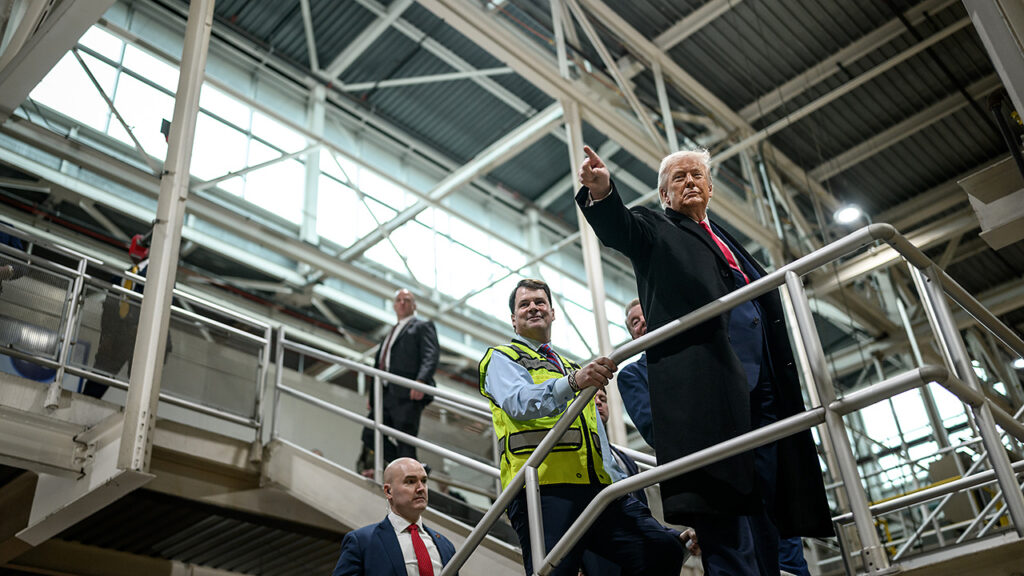
Six seconds on the factory floor that tested the limits of working-class speech.
The confrontation lasted six seconds, but its aftermath consumed a month of national attention. On January 13, 2026, as President Donald Trump toured Ford’s River Rouge Complex in Dearborn, Michigan, autoworker TJ Sabula shouted from the assembly line below: “Pedophile protector!”
The reference was unmistakable. Jeffrey Epstein, the convicted sex offender whose death in federal custody fueled conspiracy theories, had maintained decades of social ties with Trump. The president’s administration had recently released heavily redacted “Epstein files,” intensifying speculation about what— or whom— might be protected.
Trump’s reaction was immediate. Turning toward the voice, the president mouthed “f— you” twice, raised his middle finger, and added his reality-show catchphrase: “You’re fired”
. The White House later defended this as “appropriate and unambiguous,” calling Sabula “a lunatic wildly screaming expletives”
. The video evidence, however, showed a single shouted phrase and a presidential response that inverted the power dynamics of the encounter.
Ford suspended Sabula within hours. His badge was deactivated, his presence on the line temporarily erased . The company cited “respect” as a core value while deliberately obscuring the worker’s future.
But this was no ordinary employment dispute. Sabula belonged to UAW Local 600, one of American labor’s most militant locals, at the same plant where the 1937 “Battle of the Overpass” helped catalyze the union’s recognition. The UAW’s response was swift and strategically sophisticated.
Within 24 hours, Ford Department Director Laura Dickerson transformed the narrative from “misconduct” to “constitutional rights”
:
“The autoworker at the Dearborn Truck Plant is a proud member of a strong and fighting union—the UAW. He believes in freedom of speech, a principle we wholeheartedly embrace.”
The statement emphasized contractual protections: negotiated safeguards for worker expression, limitations on discipline, and grievance procedures that could extend disputes across months
Grassroots solidarity manifested financially. Within hours, GoFundMe campaigns appeared—”TJ Sabula is a patriot!!” and “Support Ford Worker TJ Sabula during suspension”
. By January 21, contributions approached $810,000—several years of autoworker wages raised by strangers responding to viral political confrontation
The fundraising revealed resonance beyond traditional labor constituencies: progressive activists, anti-Trump Republicans, Epstein case obsessives, and free speech absolutists united by opposition to the power dynamics on display.
Sabula embraced his symbolic role. In a Washington Post interview, he expressed “no regrets whatsoever”
: “I don’t feel as though fate looks upon you often, and when it does, you better be ready to seize the opportunity. And today I think I did that”
. He also articulated genuine fear: “I believe I will be targeted for political retribution for embarrassing Trump in front of his friends”
The resolution arrived February 9, 2026. At the UAW’s Community Action Program Conference in Washington, D.C., Vice President Dickerson announced before 1,000 union representatives: “TJ, we got your back”
Crucially: “He has no discipline on his record.” The suspension had ended; the investigation concluded; the worker restored with personnel file unblemished
Dickerson’s framing was explicitly political: “This ain’t ‘The Apprentice,'” she declared, referencing Trump’s NBC reality show
. The message was unmistakable: industrial employment was not entertainment, workers were not props, and presidential displeasure did not constitute grounds for termination.
She continued: “Unfortunately in that moment we saw what the current president really thinks about working people and the way he responded—he gave us the middle finger”
UAW President Shawn Fain amplified this in his keynote: “Shout out brother TJ”—a member who “put his constitutional rights to work” and “put his union rights to work”
. The incident was elevated from individual confrontation to movement mythology—a modern Battle of the Overpass.
Ford’s response remained opaque: “This is a personnel matter, and we’re not going to comment”
. The White House similarly declined to address the president’s role
Political figures filled the silence. Representative Debbie Dingell (D-Ann Arbor) had inquired about Sabula’s status, emphasizing that “the UAW worker was expressing his right to free speech”
. Representative Rashida Tlaib (D-Detroit) connected the incident to broader accountability: “I feel very strongly that Ford Motor Company is sending a message that people can’t stand up for sexual abuse survivors”
The Democratic National Committee redirected toward economic policy: “As working families struggle to make ends meet in Trump’s economy, the Trump family and their wealthy donors keep getting richer—there’s no bigger ‘F-you’ than that”
. DNC messaging chief Tim Hogan added: “Why does the mere mention of Epstein set him off?”
The incident illuminates critical fault lines. First, the persistent vitality of industrial unionism: the UAW’s ability to protect a member who directly insulted a sitting president reflects contractual density and political sophistication distinguishing major manufacturing unions from fragmented service-sector labor.
Second, the constructed nature of workplace rights. Sabula’s shout was not First Amendment-protected in any strict legal sense—the Constitution constrains state action, not private employment. His protection derived from contractual rights negotiated by the union, public sympathy mobilized through viral media, and Ford’s calculation that disciplining him would generate more reputational damage than tolerance. The “free speech” celebrated was not constitutional but contractual and political—workplace rights built through collective power rather than judicial interpretation.
Third, the fragility of presidential image management. Trump’s middle-finger response, however “appropriate” the White House deemed it, contradicted the populist persona constructed across decades. The factory tour was supposed to celebrate American manufacturing; instead, it became theater of class antagonism, with the president cast as antagonist.
Finally, crowdfunding as political expression. The $800,000+ raised represents not merely financial support but narrative investment—thousands purchasing symbolic stakes in resistance to power, transforming individual employment disputes into collective causes.
TJ Sabula returned to the Rouge assembly line, employment secured, disciplinary record clean. The viral video remains preserved as documentation of when performed presidential rituals collided with unscripted working-class consciousness.
For the UAW, mobilizing energy and ideological clarity. For Ford, a lesson in political visibility costs—“six seconds out of an hour tour,” as Executive Chairman Bill Ford characterized it, requiring weeks of negotiation
.
The image of the raised middle finger—gesture returned, power dynamic inverted—persists as emblematic of when a Michigan line worker spoke truth to power and, through organized labor’s machinery, survived.
Timeline
| Date | Event |
|---|---|
| Jan 13, 2026 | Confrontation; Sabula shouts “pedophile protector”; Trump responds with obscenity and gesture |
| Jan 13-14 | Ford suspends Sabula; UAW issues support statement |
| Jan 14-21 | Fundraising exceeds $810,000 |
| Feb 9, 2026 | UAW announces: “no discipline on his record” |