
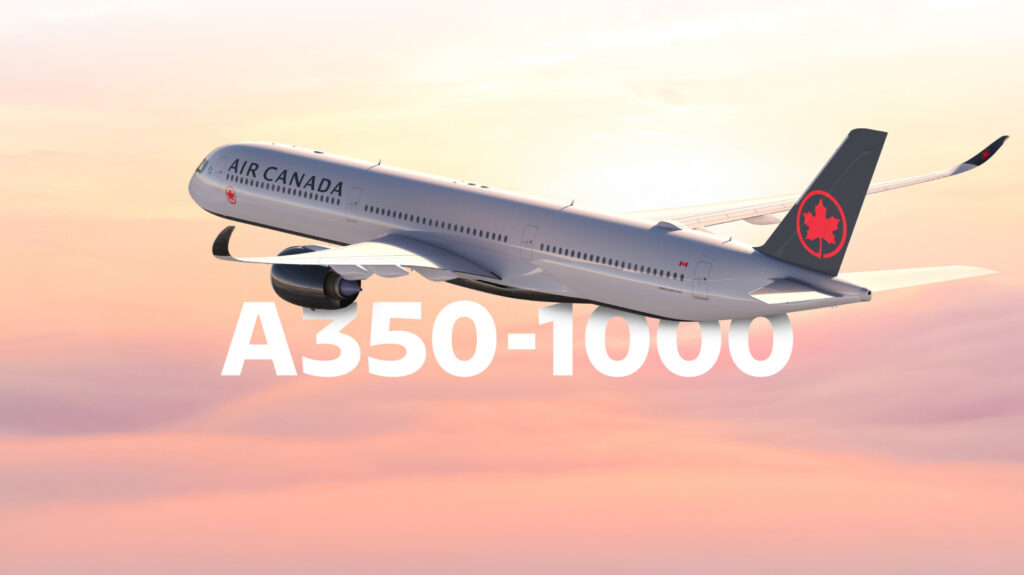
The Maple Leaf spreads its wings further than ever before.
In the calculus of modern aviation, geography is destiny. For Air Canada, perched on the northern rim of North America, this truth has always dictated the machinery of its ambition. The airline does not merely connect cities; it bridges continents across the planet’s widest oceans, often against the punishing headwinds of the North Pacific or the merciless arithmetic of ultra-long-haul economics.
Now, after nearly three decades of allegiance to Boeing’s widebody dynasty, the flag carrier has turned eastward to Toulouse. On a crisp February morning in Montréal, Air Canada unveiled what it quietly orchestrated months prior: a firm order for eight Airbus A350-1000 aircraft, with rights to acquire eight more. The first of these carbon-composite leviathans will arrive in the latter half of 2030, carrying with them the promise of a transformed global network.
The announcement, long speculated upon in aviation circles, marks more than a fleet renewal. It represents a strategic recalibration—a bet that the future of intercontinental travel belongs not to the largest possible aircraft, but to the most intelligent ones.


The Aircraft: Engineering as Poetry
At seventy-three meters from nose to tail, the A350-1000 is the largest variant of Airbus’s twin-aisle family, yet it moves through the atmosphere with a lightness that borders on paradox. More than half its structure is woven from carbon-fiber composites, rendering it approximately thirty to forty tonnes lighter than the aluminum-heavy Boeing 777-300ERs it will eventually replace. This is aircraft design as haiku: maximum capability, minimum weight.
Powered by two Rolls-Royce Trent XWB-97 engines—the most efficient large turbofans ever built—the A350-1000 promises a twenty-five percent reduction in fuel consumption compared to previous-generation widebodies. For an airline operating in an era of volatile energy costs and mounting environmental scrutiny, such efficiency is not merely desirable; it is existential.
But the numbers, impressive as they are, tell only half the story. The A350-1000’s true distinction lies in its reach. With a published range approaching 9,000 nautical miles, the aircraft can connect Toronto or Vancouver to virtually any point on Earth without the indignity of a refueling stop. Sydney. Singapore. Mumbai. These are no longer destinations requiring compromise; they are nonstop realities.
The Strategy: Flexibility as Currency
Mark Galardo, Air Canada’s Chief Commercial Officer, speaks of the acquisition with the measured enthusiasm of a man who has spent years negotiating its possibility. “What we like the most is the range capability,” he noted during the airline’s February earnings call, “so that gives us options to grow into new markets whether it be in the Indian subcontinent, Southeast Asia or Australia.”
This flexibility—optionality, in the clinical language of corporate strategy—is the A350-1000’s most valuable payload. For Air Canada, whose hubs sit significantly farther north than those of its American competitors, every additional nautical mile of range translates into competitive advantage. It means flying fully loaded against winter headwinds without leaving passengers or profit margin behind. It means opening routes that economics previously forbade.
The timing is deliberate. By 2030, Air Canada’s venerable Boeing 777-300ERs—workhorses of the transpacific trade for nearly two decades—will approach the natural horizon of their operational lives. The A350s arrive not as emergency replacements, but as considered succession, allowing the airline to modernize without the trauma of compressed timelines.
The Cabin: Altitude as Luxury
Beyond the flight deck and the fuel tanks, the A350-1000 offers something less quantifiable but equally precious: the physiology of comfort. Airbus has engineered this aircraft for human endurance at its limits. The cabin altitude is pressurized to the equivalent of 6,000 feet—2,000 feet lower than conventional widebodies—reducing the subtle hypoxia that exacerbates jet lag. Humidity levels are higher. Noise, that constant companion of long-haul flight, is diminished through advanced acoustic engineering.
Air Canada promises its “new cabin standard” aboard these aircraft, though details remain guarded. One imagines—a journalist’s speculation, nothing more—a refinement of the airline’s Signature Class suites, perhaps augmented by the spatial generosity that the A350’s wider fuselage permits. The -1000 variant offers room for approximately 350 to 410 passengers in typical configurations, a Goldilocks zone between the capacity of the 777 and the efficiency of the 787.
The Deeper Currents
There is symbolism in this order that transcends fleet planning. Air Canada has not purchased Airbus widebodies since the late 1990s, when the A340 still roamed the skies. The return to Toulouse, even as the airline awaits fourteen Boeing 787-10s and expands its Airbus narrowbody operations, speaks to a philosophy of diversification. In an industry perennially vulnerable to delivery delays and technical teething problems—exemplified by the protracted gestation of Boeing’s 777X—placing strategic bets across manufacturers is prudent risk management.
Yet this is no repudiation of Seattle. Air Canada’s fleet will remain predominantly Boeing for years to come. Rather, the A350-1000 represents a complementary capability, a specialized instrument for the most demanding routes in the network.
The Horizon
For the traveling public, the implications unfold gradually. The first A350-1000 will not grace Canadian skies until 2030, and the full fleet integration will extend into the mid-2030s. But the trajectory is set. Air Canada has chosen its instrument for the next era of global aviation—an era defined not by hub congestion and four-engine excess, but by surgical precision, environmental responsibility, and the quiet luxury of arriving refreshed after eighteen hours aloft.
In the hangars of Toulouse, where the first Canadian-bound fuselages will soon take shape, engineers understand what this order represents. The A350-1000 is not merely an aircraft; it is an argument about the future of long-haul travel. Air Canada, with its unique geographic imperatives and global ambitions, has found that argument persuasive.
The Maple Leaf, it seems, is preparing to fly further than ever before.
Specifications at a Glance
| Aircraft | Airbus A350-1000 |
|---|---|
| Length | 73.79 meters |
| Range | ~9,000 nautical miles |
| Engines | 2× Rolls-Royce Trent XWB-97 |
| Fuel Efficiency | 25% improvement vs. previous generation |
| Air Canada Commitment | 8 firm, 8 options |
| First Delivery | H2 2030 |
Sources: Aviation Week, Airbus Press Release, Air Canada Investor Relations, One Mile at a Time, Business Traveller